AI system design diagram generator.
For a design doc, a review, or the whiteboard round where you have forty minutes and need the shape to be right.
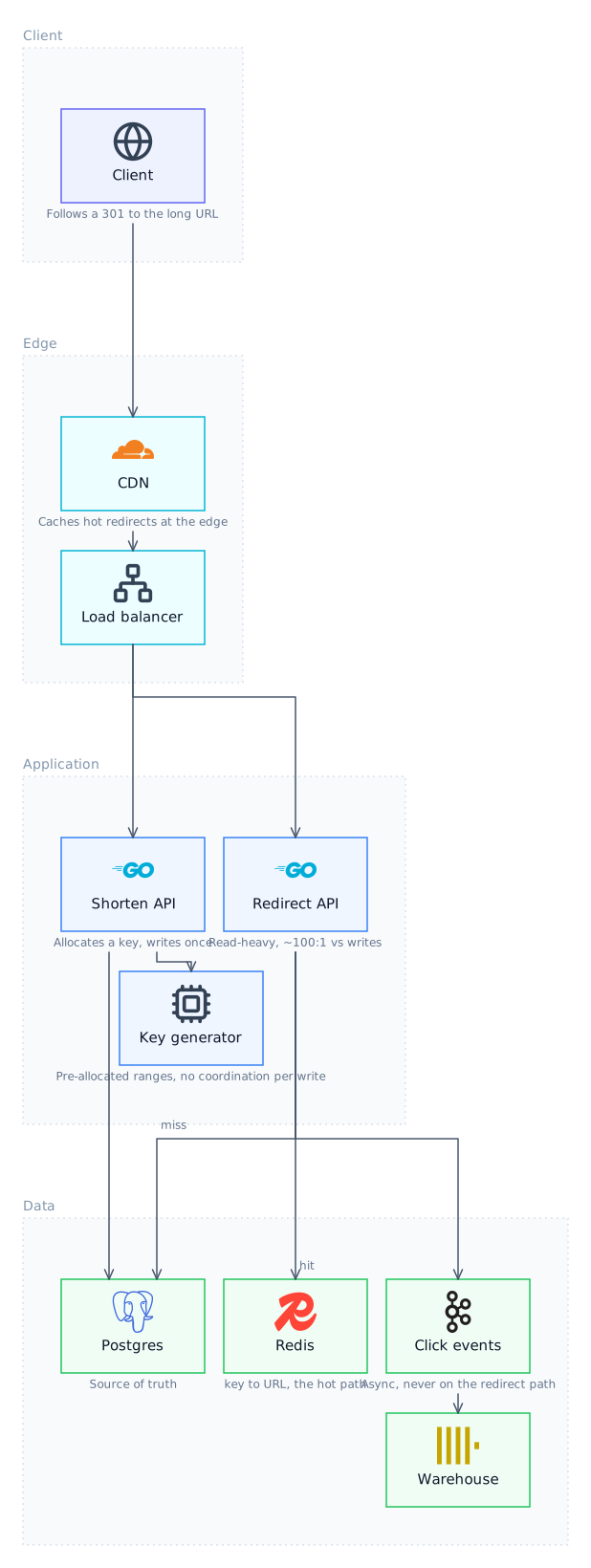
What makes a system design diagram good
A good one is legible in ten seconds and survives being questioned for an hour. That means a small number of boxes, clear direction of flow, and every component carrying a reason for existing rather than just a name. The failure mode is completeness: a diagram containing everything is a diagram nobody reads, and in an interview it signals that you cannot identify what matters.
How Lucid Train draws one
Describe what you want, or point it at a repository. The agent emits a semantic graph of nodes and edges with no coordinates, and the ELK layout engine computes positions and orthogonal routing. That separation is the reason the output cannot come back with boxes overlapping or arrows crossing through cards, which is the characteristic failure when a language model is asked to place things on a canvas itself. It also means editing is editing the graph: change a component and the layout re-solves rather than drifting out of alignment.
Iterating is the point
System design is a conversation, and the diagram changes several times during it. Because the agent emits a graph rather than a picture, adding a cache or splitting a service is a change to the model and the layout re-solves cleanly. Compare that with dragging boxes, where every change costs alignment work and eventually you stop making changes you should make.
Start from a reference design
There are 24 worked reference architectures with the design tradeoffs written out, covering the systems that come up most: URL shorteners, chat, payments, feeds, rate limiters, booking. They are a faster starting point than an empty canvas and they contain the arguments, not just the boxes.
Local, offline, your models
It runs as a desktop application. Against a local Ollama model the whole thing works offline with no API key and no telemetry, which is the practical difference from every browser-based diagram tool: your architecture never leaves the machine.
The diagrams a design review usually wants
| Diagram | The question it answers |
|---|---|
| Context | What is inside the system and what is outside it |
| Container or component | What are the deployable pieces and how do they connect |
| Data flow | What happens to one request, end to end |
| Data model | What is stored, and where |
| Failure | What breaks first, and what happens when it does |
| Sequence | The ordering of an interaction across components |
Try it
Questions
Is this useful for system design interviews?
For preparation, yes: working through reference designs and being able to redraw them quickly builds the vocabulary. Most interviews themselves are conducted on the interviewer's whiteboard tool, so treat this as practice rather than as something you will use in the room.
What is the difference between this and an architecture diagram?
Mostly audience. An architecture diagram documents a system that exists; a system design diagram argues for one that does not yet. The notation is the same, but the second usually carries capacity numbers and alternatives considered.
Can it produce several views of the same system?
Yes, that is the act structure: context, containers, data flow, data and failure as separate diagrams of one system. Trying to put all five into one picture is what makes design docs unreadable.
Does it work offline?
Fully, with a local model. It is a desktop application rather than a web app, which is what makes that possible.
Related
- AI Sequence Diagram GeneratorFor when the question is not what the components are but in what order they talk, and what happens when step four fails.
- AI ER Diagram GeneratorPoint it at the schema you already have. The relationships are declared, so the diagram is a rendering rather than an interpretation.
- AI Data Flow Diagram GeneratorWhere the data comes from, what transforms it, where it lands, and which of those crossings leave your control.
- AI C4 Model Diagram GeneratorOne system, drawn at three levels of zoom, so each diagram has one audience instead of trying to serve all of them.
Last updated